Counterfeiting poses a growing global challenge, affecting industries from pharmaceuticals and electronics to food and luxury goods. To address this issue, the European research project QuantumPUF officially launched on September 1, 2026, with nearly €3 million in funding from the European Innovation Council (EIC). The project brings together seven partners from five European countries to develop innovative authentication technologies based on quantum physics and photonics.
QuantumPUF aims to create a new generation of Physical Unclonable Functions (PUFs) that use the unique physical properties of materials to establish secure identities that are extremely difficult to copy or reproduce. The project will develop three types of photonic PUFs, combining advanced luminescent materials with scalable manufacturing techniques, such as inkjet printing, and portable optical readout systems that can be integrated into smartphones.
Security grounded in the laws of physics
By combining quantum and photonic principles with advanced cryptography, QuantumPUF seeks to provide robust protection against counterfeiting, cloning and emerging cyber threats, including quantum attacks. The proposed solutions will also prioritise affordability, energy efficiency, portability and environmental sustainability. Coordinated by Instituto de Telecomunicações in Portugal, the consortium brings together expertise from Germany, Croatia, Portugal, Spain and Switzerland in photonics, materials science, quantum information and cryptography.
“The scale and sophistication of counterfeiting requires us to rethink how authenticity is established. QuantumPUF explores a fundamentally different approach,” explains Paulo André, Project Coordinator at Instituto de Telecomunicações.
Through its interdisciplinary approach, QuantumPUF aims to translate cutting-edge quantum research into practical authentication solutions, contributing to safer supply chains, more trustworthy products and a more secure digital and physical world.
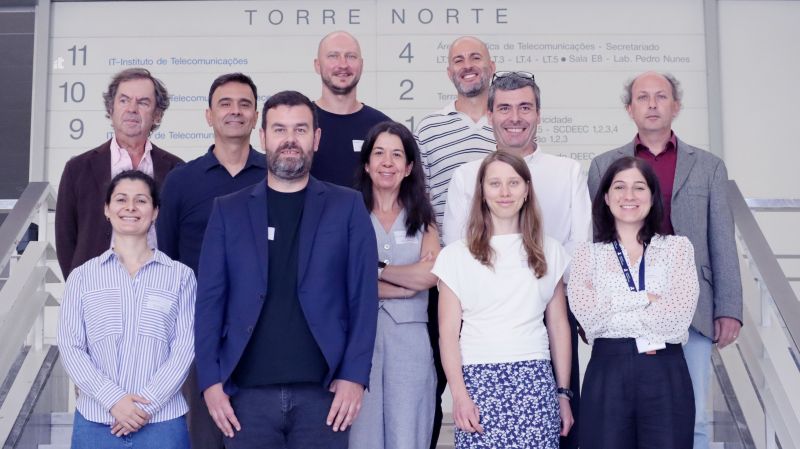
The project officially kicked off on 7 October 2026 in Lisbon, bringing together all seven consortium partners from five European countries: Humboldt-Universität zu Berlin (Germany), Research and Innovation Services – RISE (Croatia), Instituto de Telecomunicações (project coordinator), Proposta Figurada and Universidade de Aveiro (Portugal), Universidad de Vigo (Spain), and Université de Genève (Switzerland). The meeting marked the start of a collaborative effort to turn cutting-edge quantum research into practical, secure and sustainable authentication solutions.
Learn more about the project here.
Follow the team on LinkedIn.